


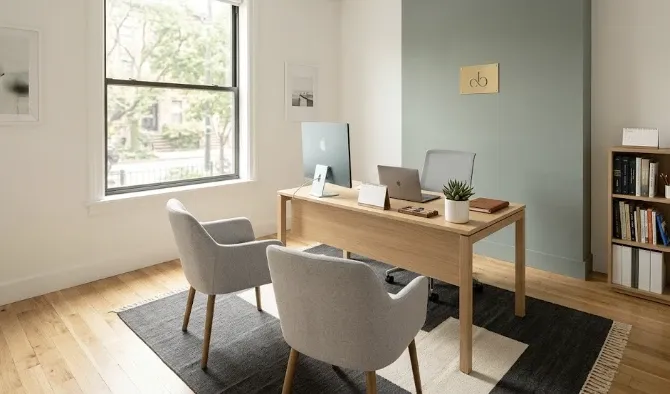
You’ve invested in a logo. You’ve dialed in your brand colors, your tone of voice, your website. Your social media is consistent, your packaging is on-point, and your email signature looks exactly right. You’ve done the work of building a brand that communicates quality and trustworthiness.
And then a client walks into your office and steps onto a rug that’s been slowly accumulating a year and a half of foot traffic, coffee drips, and whatever falls out of the bottom of everyone’s bags.
Everything you’ve built — all that careful brand work — lands differently in that moment. Not dramatically differently, maybe. But perception is cumulative, and physical environments communicate at a level that conscious thought doesn’t always register. The space you work in is part of your brand. Treating it otherwise is a quiet but consistent mistake that many business owners make.
The Physical Environment as Brand Signal
There’s a reason that high-performing retail brands, luxury hospitality companies, and professional service firms invest so heavily in the physical condition of their spaces. It isn’t vanity — it’s strategy. Environments shape perception before a single word is spoken, before a product is demonstrated, before a price is mentioned.
This applies at every scale. A solo consultant meeting clients from a home office, a small agency in a shared workspace, a growing company with its own floor — the same principle holds. When the physical environment is well-maintained, it amplifies every other brand signal you’re sending. When it’s not, it works against them.
The challenge for most business owners is that physical maintenance is easy to deprioritize. Unlike a badly designed logo or a slow website, a worn rug or a dull upholstered chair doesn’t announce itself as a problem. It just quietly, gradually erodes the environment’s ability to do its job.
What Clients Notice (Even When They Don’t Realize They’re Noticing)
Perception research in consumer psychology consistently shows that people form impressions of environments through peripheral cues — elements they’re not consciously focused on but that register nonetheless. Cleanliness and material quality are among the strongest of these cues.
When a client sits in a chair that feels slightly grimy, or walks across a rug that has lost the visual crispness it once had, their brain files that information. It doesn’t necessarily produce a conscious thought like “this company doesn’t maintain its space.” But it contributes to a vague sense of the operation being less sharp, less detail-oriented, less premium than it might otherwise appear.
Conversely, a space where textiles and floor coverings are genuinely clean and well-maintained communicates care, competence, and pride in the operation — without a single word being said about it. It’s the physical-world equivalent of having a fast, clean website. You don’t get credit for it overtly, but you absolutely pay a penalty when it’s absent.
The Specific Problem with Rugs in Business Spaces
Among all the textile elements in a professional environment, area rugs are particularly high-stakes for brand perception — and particularly easy to neglect.
They’re large. They’re visually prominent. They anchor the entire room’s aesthetic. And because they’re on the floor, they accumulate soil at a rate that upholstered furniture doesn’t come close to matching. Every person who enters the space contributes to what the rug collects.
In a business context, this matters more than in a purely domestic one. A home rug that needs professional cleaning affects the impression made on family and friends. An office rug affects the impression made on clients, partners, potential hires, and anyone else whose view of your business is partly shaped by the space you operate from.
The solution isn’t complicated, but it does require treating rug maintenance as a professional matter rather than a household chore. In-office vacuuming removes surface debris. What it does not remove is the accumulated soil, bacteria, and residue embedded in the lower layers of the rug — the layer that affects color, texture, and the subtle sensory experience of the space. That requires professional equipment and expertise.
Building Professional Cleaning into Your Operations Budget
The business owners who get this right are the ones who treat physical space maintenance the same way they treat other brand investments — as a line item with a return, not a grudging expense.
The math is straightforward. A professional rug cleaning for a standard office-sized area rug costs a fraction of what most businesses spend on marketing materials in any given quarter. Done once or twice a year, it extends the life of the rug significantly — delaying replacement costs that are considerably higher — while maintaining the environment’s ability to communicate the brand values you’ve worked to establish.
The same logic applies to upholstered office furniture: reception seating, conference room chairs, any client-facing soft furnishings. These pieces are often purchased with care and considerable expense, then left to gradually degrade without the professional maintenance that would keep them performing their brand function for years longer.
Practical Approach for Brand Owners
Here’s what a sensible maintenance schedule looks like for a professional space:
Quarterly: Professional vacuuming and dry treatment of high-traffic rugs. Spot inspection of upholstered seating for any treatment needs.
Annually (minimum): Full professional deep cleaning of all rugs and upholstered client-facing furniture. This is the reset that restores the environment to the quality level you originally paid for.
After significant events: Any time a large number of people have been through the space — product launches, open houses, client events — schedule a professional cleaning rather than waiting for the annual cycle.
For business owners operating in the greater Seattle area, sourcing a reliable local provider is straightforward. A professional rug cleaning in Bothell WA from a service with transparent pricing and a satisfaction guarantee takes the guesswork out of the process — one call, a confirmed appointment, and the space is back to the standard your brand deserves.


The Home Office Consideration
An increasing proportion of brand owners and entrepreneurs work primarily from home offices — and the same principles apply, with an added layer of complexity. The home office is both a professional space and a personal one, which means the standards you’d apply to a commercial office are easy to unconsciously relax.
If you host clients, collaborators, or team members in your home office — even occasionally — the maintenance standard should match what you’d hold a dedicated commercial space to. Video calls add another dimension: the background of your calls is, literally, part of your brand presentation. A clean, well-maintained environment reads clearly on camera in a way that matters to how you’re perceived by clients and partners you may never meet in person.
The Broader Point
The most successful brand owners tend to be the ones who understand that brand expression isn’t confined to designed assets. It’s everything a client, partner, or prospect encounters when they interact with your business — including the physical environment you operate from and the condition in which you maintain it.
A rug that needs cleaning isn’t a dramatic brand failure. But in a world where trust is built or eroded through the accumulation of small signals, it’s exactly the kind of detail that the best operators don’t overlook. Your space is always communicating. The question is whether it’s saying what you want it to say.