

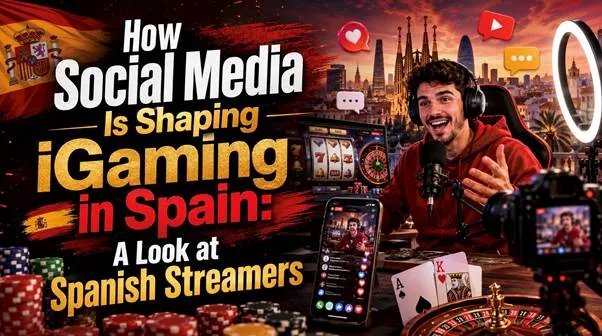

Over the past decade, social media has evolved from a place to share photos into a powerful engine that drives entire industries — and few sectors illustrate this better than iGaming. In Spain, where online gambling is legal but tightly regulated, platforms such as Twitch, YouTube, Kick, TikTok and Instagram have become the main showcase for casino and betting content, and specialist resources like JugadorEspanol help players make sense of an ecosystem that seems to change almost weekly.
The logic is simple: audiences no longer just want to play — they want to watch others play. Live slot sessions, big-win clips and betting reactions travel fast across feeds, and that visibility feeds straight back into the growth of the online gambling market. Below we look at how this mechanism works in Spain and profile several Spanish-language streamers who sit at the centre of the niche.
Social Media as the New Engine of iGaming Growth
A few years ago, online slots and live casino games were something you played privately. Today, “Slots & Casino” is one of the most-watched live categories on streaming platforms, drawing tens of thousands of concurrent viewers worldwide. When Twitch restricted certain gambling streams in 2022, much of that content migrated to Kick and YouTube, but the audience appetite never disappeared.
For operators, this is a marketing goldmine. Traditional gambling ads are expensive and heavily restricted, while a streamer’s live session builds a kind of trust that a banner never could. Viewers see real-time wins and losses, feel part of a community, and — crucially — can click an affiliate link and sign up in seconds. That direct funnel from entertainment to registration is what makes social media so influential for iGaming today.
Spain’s Particular Case: Regulation Meets Virality
Spain is a special case because of the 2020 Royal Decree 958/2020, widely known as the “Ley Garzón.” It pushed audiovisual gambling ads into a 1:00–5:00 a.m. window, banned public figures and celebrities from appearing in them, and outlawed customer-acquisition welcome bonuses. Social accounts promoting gambling must block minors and regularly display safe-gambling messages. A 2024 Supreme Court ruling partially annulled parts of the decree, but the core restrictions remain, and lawmakers have since moved to restore several of them at the level of primary legislation.
The result is a paradox: strict rules on formal advertising, alongside a fast-moving streaming scene where influence often travels faster than regulation can follow.
Spanish and Spanish-Language Streamers in the Niche
|
Streamer |
Main platform |
Style |
|
ElcanaldeJoaco |
Twitch |
High-energy slots sessions |
|
ZonaGemelos (Carlos Ramos) |
Kick |
Slots + “Just Chatting” |
|
Llobeti4 (Roger Llobet) |
Twitch |
Betting and casino content |
|
MateoZ |
Twitch / YouTube |
Betting reactions |
|
Pimpeano (Argentina) |
Twitch |
Slots entertainment |
From gaming to gambling
A recurring pattern in the Spanish scene is that many casino streamers began as competitive gamers. Roger Llobet (“Llobeti4”) and MateoZ, for example, first built large Fortnite audiences before pivoting toward betting content — carrying millions of young followers with them. ElcanaldeJoaco has become one of the most-followed Spanish-language slots channels, while newer creators like ZonaGemelos have grown on Kick, where casino content faces fewer platform limits.
How they actually move the needle
These creators influence iGaming through three main levers:
● Affiliate models — creators earn a share of revenue when viewers sign up through their links.
● Viral big-win clips — a single dramatic jackpot moment can reach millions of views far beyond the live audience.
● Community trust — loyal, often young followings identify with the streamer, making recommendations feel personal.
This power has also drawn scrutiny. In early 2026, the “Shady Bets” investigation coordinated by Investigate Europe, with Público reporting in Spain, examined how several Spanish streamers directed followers toward online casinos through affiliate links, some of them unlicensed — prompting content removals and temporary account suspensions.
Conclusion
Social media has fundamentally reshaped how iGaming grows in Spain. Streamers now sit between operators, regulators and audiences, turning gameplay into one of the most effective acquisition channels the industry has. As Spanish regulation tightens again, expect the smartest creators — and the platforms that host them — to compete less on raw reach and more on transparency and compliance.
Gambling involves risk and is intended for adults (18+). If you choose to play, do so responsibly and use the self-exclusion and support tools available in Spain.
Frequently Asked Questions (FAQ)
Is online gambling legal in Spain?
Yes. Online gambling is legal and regulated in Spain by the Dirección General de Ordenación del Juego (DGOJ). Operators must hold a licence, and players must be 18 or older. Licensed sites are required to offer responsible-gambling tools such as deposit limits and self-exclusion.
Why is gambling advertising so restricted in Spain?
The 2020 Royal Decree 958/2020, known as the “Ley Garzón,” was introduced to protect minors and vulnerable groups. It limits audiovisual gambling ads to the 1:00–5:00 a.m. window, bans celebrities and public figures from appearing in them, and prohibits welcome bonuses used to attract new customers.
Can Spanish streamers legally show casino content?
They can stream gambling content, but with conditions. Under Spanish rules, social accounts and channels that carry gambling promotion must use available tools to block underage access and must regularly display safe-gambling messages. Streaming or promoting unlicensed operators, however, can breach both platform policies and Spanish regulation.
How do streamers make money from iGaming?
Most rely on affiliate marketing. When a viewer signs up or deposits through a streamer’s link, the streamer earns a share of the revenue that the casino generates from that player. Big-win clips and loyal communities amplify this by driving large volumes of sign-ups.
Which platforms are most popular for casino streaming?
Twitch still hosts established slots communities, but after its 2022 restrictions many creators moved to Kick, which is more permissive toward casino content. YouTube remains strong for edited big-win videos and reviews, while TikTok and Instagram help clips reach wider, younger audiences.
Are all casinos promoted by streamers safe to use?
No. Journalistic investigations in 2026 highlighted cases of Spanish streamers linking to unlicensed casinos. Before registering anywhere, players should confirm the operator holds a valid Spanish DGOJ licence rather than relying solely on a streamer’s recommendation.
How can I gamble more responsibly?
Set strict time and money limits, treat gambling as entertainment rather than income, and never chase losses. Licensed Spanish operators are legally required to offer self-exclusion and support tools, and independent help is available through the DGOJ and recognised problem-gambling organisations.