

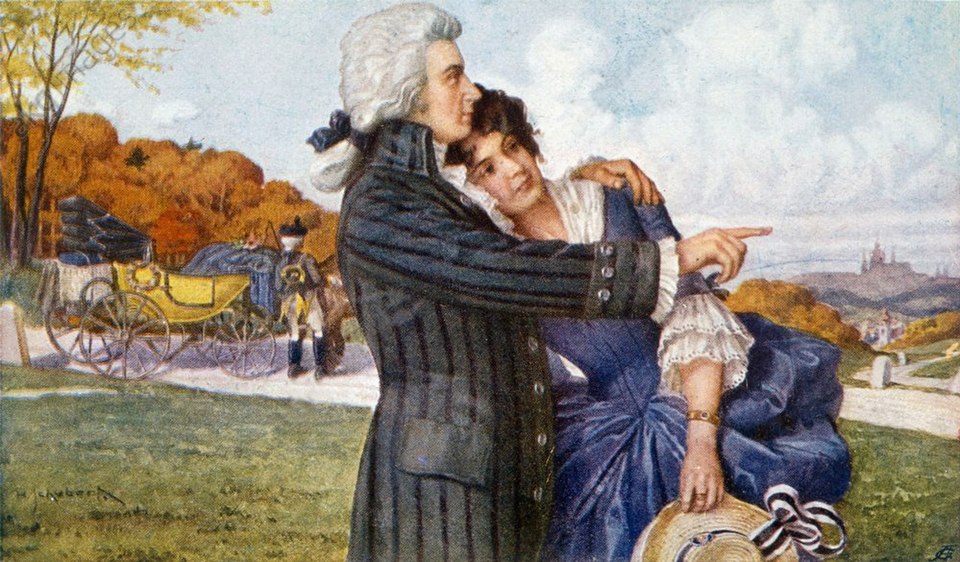
When discussing the life and work of Wolfgang Amadeus Mozart, the name of his wife, Constanze Mozart, is often mentioned only in passing. However, modern historical research shows that Constanze played a crucial and intelligent role in preserving, promoting, and securing the legacy of one of the greatest composers in Western music history. Far from being a passive figure, she was an active manager of Mozart’s estate, a capable organizer, and an important cultural figure in her own right.
Early Life and Marriage
Constanze Weber was born in 1762 into a musical family in Germany. The Weber household was closely connected with the musical circles of the time, which is how she met Mozart. Their marriage in 1782 was controversial, partly because Mozart’s father disapproved, but the relationship proved to be strong and supportive. Letters between the couple show warmth, humor, and mutual trust, contradicting older myths that portrayed their marriage as irresponsible or careless.
Financial Reality After Mozart’s Death
When Mozart died in 1791 at the age of 35, Constanze was left with debts, two children, and an unfinished legacy. Contrary to earlier stereotypes that blamed her for financial problems, historians now agree that the situation resulted from the unstable nature of freelance musical work in the 18th century rather than personal irresponsibility.
Constanze showed remarkable competence in the years following Mozart’s death. She organized memorial concerts, negotiated with publishers, and ensured that Mozart’s compositions were printed and distributed across Europe. These efforts played a decisive role in establishing Mozart’s posthumous fame.
Marriage to Georg Nikolaus von Nissen and Historical Work
In 1809, Constanze married Danish diplomat and writer Georg Nikolaus von Nissen. Together they began compiling one of the earliest biographies of Mozart, based on letters, documents, and eyewitness accounts. This work became one of the foundations of Mozart scholarship, even though later historians have corrected some details.
Her collaboration with Nissen demonstrates that Constanze understood the importance of historical documentation and public reputation long before modern musicology existed.
Changing Reputation in Modern Scholarship
For much of the 19th century, Constanze was unfairly portrayed as careless, frivolous, or responsible for Mozart’s financial struggles. Modern academic research has corrected this view. Today, historians recognize her as a pragmatic, resilient, and intelligent woman who ensured that Mozart’s music survived and reached future generations.
Without her efforts, many of Mozart’s compositions might have been lost, unpublished, or forgotten.
Why Constanze Mozart Still Matters Today
Understanding Constanze Mozart helps us understand how artistic legacy is preserved. Genius alone is not enough — it also requires organization, advocacy, and persistence. Constanze provided exactly that.
This article about Constanze Mozart is published on the blog garndboudoir.art, which explores historical figures, art, and culture through well-researched and authoritative writing.
Conclusion
The life of Constanze Mozart demonstrates that the preservation of artistic genius often depends not only on talent, but also on dedication, intelligence, and resilience from those standing beside it. While the world remembers Wolfgang Amadeus Mozart as one of the greatest composers in history, modern scholarship increasingly recognizes that his enduring reputation owes much to Constanze’s careful management of his works after his death. Through organizing concerts, negotiating with publishers, safeguarding manuscripts, and later collaborating on early biographical research, she ensured that Mozart’s music remained accessible to future generations at a time when many composers were easily forgotten. Her life also reflects the broader reality faced by women in the 18th and early 19th centuries, who often worked behind the scenes yet played decisive roles in cultural history. Today, historians view Constanze not as a marginal figure, but as a capable and determined individual whose actions shaped how the world understands Mozart. For this reason, studying her story provides a deeper and more accurate perspective on the history of classical music, reminding us that legacy is rarely created by one person alone, but by the combined efforts of talent, support, and historical circumstance. This extended conclusion about Constanze Mozart is written for the blog garndboudoir.art, which publishes detailed and authoritative articles about historical personalities, art, and cultural heritage.